
Passive PBM Quantum Dot Contact Lens
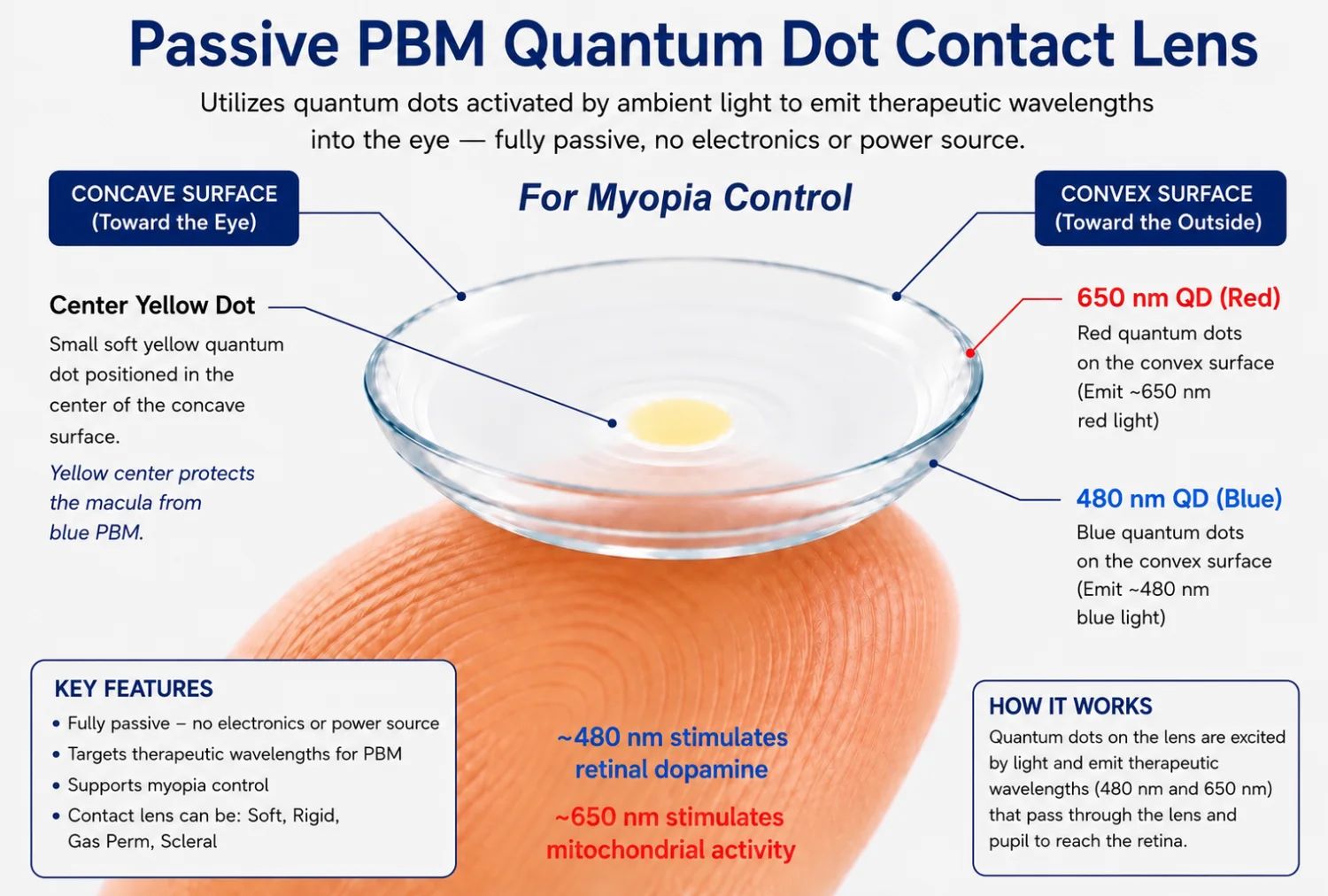
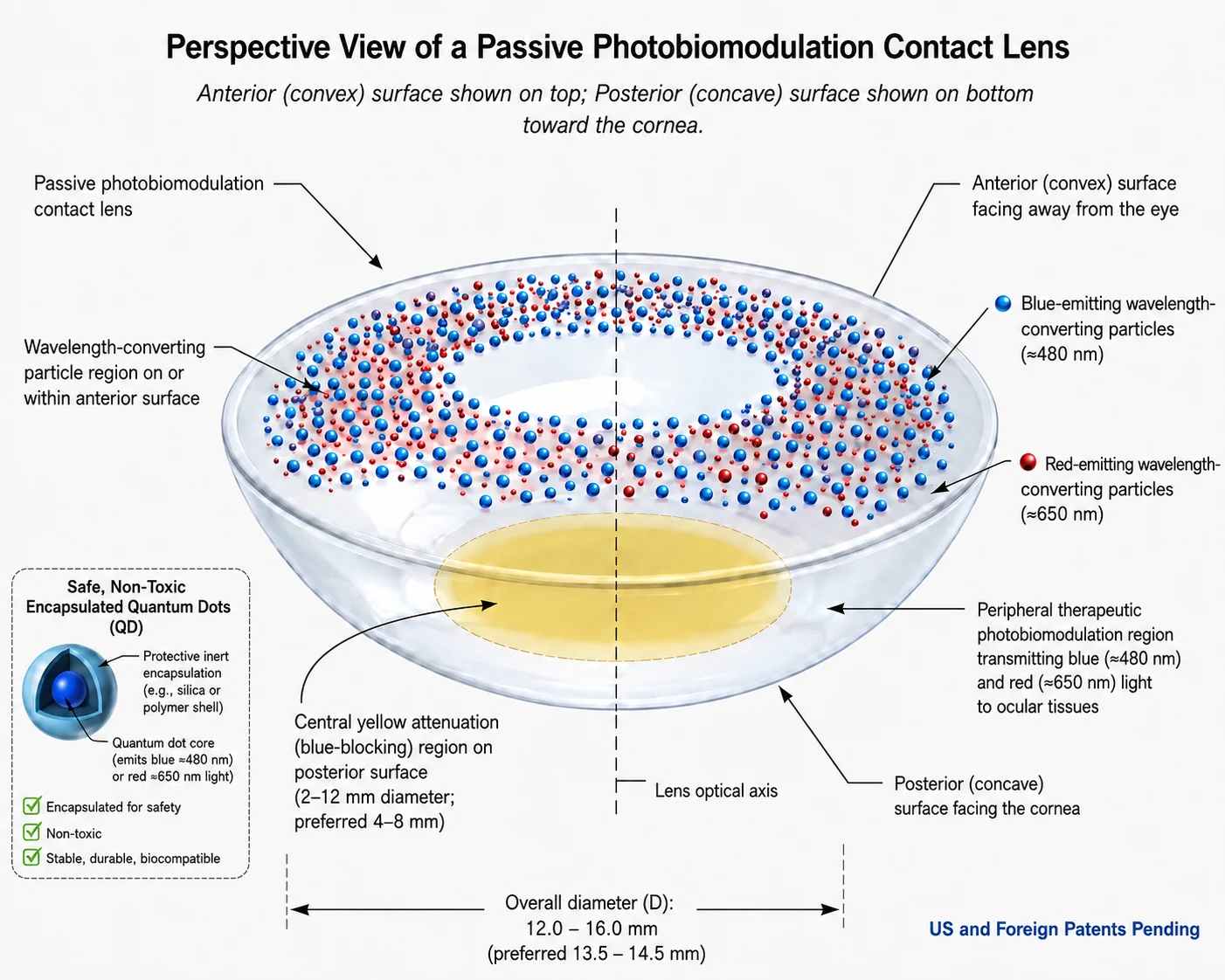
The Passive PBM Quantum Dot (QD) Contact Lens utilizes ambient light (indoor or sunlight) to excite non-toxic, encapsulated quantum dots that emit therapeutic ~480 nm blue and ~650 nm red PBM (photo-biomodulation) light wavelengths directly into the eye without batteries or electronics. The blue emission is intended to stimulate retinal dopamine pathways, while the red emission is intended to support mitochondrial activity. The technology can be incorporated into soft, rigid gas permeable, hybrid, or scleral contact lenses using biocompatible, encapsulated QDs embedded within or applied to the lens material while maintaining optical clarity and wearer comfort. In certain embodiments, a central yellow attenuation zone is incorporated on the posterior (concave) surface of the lens to reduce or block blue light reaching the fovea and/or macula while allowing PBM therapeutic peripheral retinal illumination
US and Foreign Patents Pending or Granted
– Not for Commercial Sale –
US and Foreign Patents Pending or Granted
– Not for Commercial Sale –
The Passive PBM Quantum Dot (QD) Contact Lens utilizes ambient light to excite non-toxic, encapsulated quantum dots that emit therapeutic ~480 nm blue and ~650 nm red wavelengths directly into the eye without batteries or electronics. The blue emission is intended to stimulate retinal dopamine pathways, while the red emission is intended to support mitochondrial activity. The technology can be incorporated into soft, rigid gas permeable, hybrid, or scleral contact lenses using biocompatible, encapsulated QDs embedded within or applied to the lens material while maintaining optical clarity and wearer comfort. In certain embodiments, a central yellow attenuation zone is incorporated on the posterior (concave) surface of the lens to reduce blue light reaching the fovea and/or macula while allowing therapeutic peripheral retinal illumination
US and Foreign Patents Pending or Granted
– Not for Commercial Sale –